
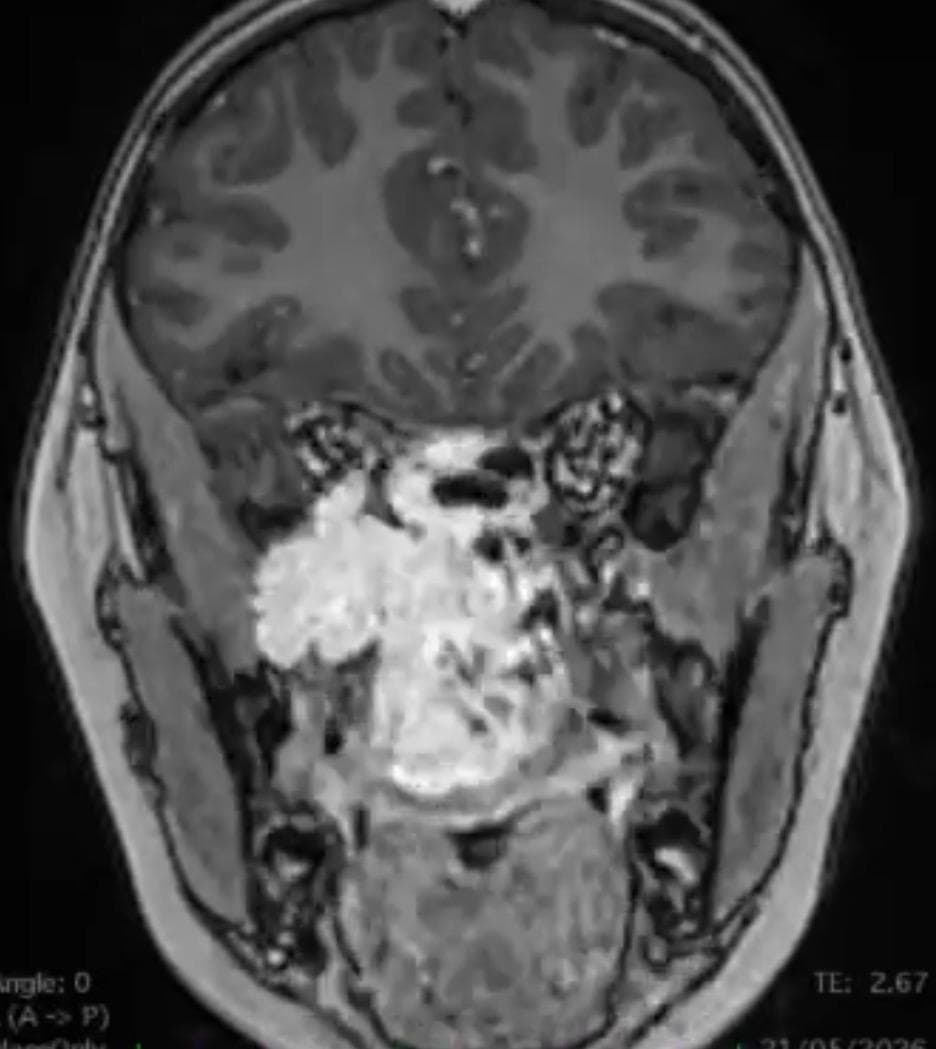
Giant juvenile nasopharyngeal angiofibroma treated via an endoscopic endonasal approach

A 9-year-old patient presented with progressive nasal obstruction, heavy snoring, episodes of sleep apnea, and recurrent nosebleeds.

MRI revealed a large juvenile nasopharyngeal angiofibroma — a benign but highly vascular lesion filling the nasopharynx and extending into the nasal cavities, which explained the patient's symptoms.

As part of surgical planning, a diagnostic cerebral angiography was performed to identify the arteries supplying the tumor. A selective embolization of its main feeding vessels was then carried out to significantly reduce bleeding during surgery.

Our team is a referral center for the treatment of this condition through endoscopic endonasal surgery. This technique allows the tumor to be removed through the nasal cavities, without incisions or scars on the face and avoiding, in most cases, the need for craniotomies or open facial approaches.
Symptoms

  • Progressive nasal obstruction
  • Heavy snoring
  • Episodes of sleep apnea
  • Recurrent nosebleeds (epistaxis)

Diagnosis

  • Magnetic resonance imaging (MRI) — to assess the size of the tumor and its extension into the nasopharynx and nasal cavities
  • Diagnostic cerebral angiography — to identify the arteries supplying the tumor and plan the surgery

Treatment

As part of surgical planning, a selective embolization of the main vessels feeding the tumor is performed to significantly reduce bleeding during surgery.

The resection is carried out via an endoscopic endonasal approach: the tumor is removed through the nasal cavities, without incisions or scars on the face and avoiding, in most cases, craniotomies or open facial approaches. Our team is a referral center for the treatment of this condition.
Our approach

  • Preference for the endoscopic endonasal approach, without external facial incisions or scars
  • Pre-surgical embolization to minimize bleeding during surgery
  • Complete resection while preserving critical neurovascular structures, such as the cavernous sinus and cranial nerves
  • A referral team in minimally invasive skull base surgery
Clinical case

Frequently asked questions

Do you need a consultation?

If you'd like to discuss your case or get a second opinion, you can schedule an in-person or virtual consultation.

Related pathologies

Esthesioneuroblastoma or Olfactory Neuroblastoma

Esthesioneuroblastoma or Olfactory Neuroblastoma

Esthesioneuroblastoma is a rare malignant tumor of the anterior skull base originating from olfactory cells.

View pathology
Pituitary Adenomas

Pituitary Adenomas

Benign, slow-growing tumors originating from cells of the adenohypophysis, classified as functioning or non-functioning.

View pathology
Craniopharyngiomas

Craniopharyngiomas

Benign tumors of the sellar and suprasellar region derived from epithelial cells of Rathke's pouch.

View pathology